
Uncategorized

A Simple Guide to Home Possible Mortgage Loans

What is a Home Possible Mortgage?

Screen Shot 2019-02-26 at 1.08.06 PM.png

Home Possible is a Freddie Mac mortgage program which allows first-time homebuyers with moderate incomes low down payment mortgage options. These programs only require 3-5% as the minimum down payment and features private mortgage insurance (PMI) that can be canceled once your home equity reaches 20%.


How can Home Possible help me?

Screen Shot 2019-02-26 at 1.02.40 PM.png

The Home Possible and the Home Possible advantage programs are geared toward first-time homebuyers with limited funds available for down payments, but meet the rest of the lending criteria. The purpose of both programs is to finance or refinance the purchases of primary residences, 2-4 unit owner-occupied homes, and eligible manufactured properties. Home Possible programs, with backing from Freddie Mac, are able to offer reduced mortgage insurance rates and premiums, more flexible credit terms, and refinancing options for existing homeowners.


What are its Main Advantages of Each HP Program?

Screen Shot 2019-02-26 at 1.13.27 PM.png

Home Possible Home Possible Advantage
  • Income Limits: The borrower’s annual income cannot exceed 100% of the area median income limits (or higher percentage in designated high-cost areas). No income limits apply if the property is in an underserved area.
  • Eligible Property: A one- to four-unit primary residence or a manufactured home that meets the guidelines.
  • Eligible Mortgages: First-lien, fully amortizing mortgages; fixed rate and adjustable rate loans are allowed. The maturity must not exceed 30 years.
  • LTV and DTI Ratios: Max 95% LTV, DTI Determined by Loan Product Advisor or 45% if manually underwritten.
  • Income Limits: Loan Product Advisor is used to determine whether the borrower’s income exceeds the product advisor limits.
  • Eligible Property: A 1-unit primary residence. Manufactured Homes not permitted
  • Eligible Mortgages: First-lien, fully amortizing mortgages; fixed rate loans only. Loan term cannot exceed 30 years.
  • LTV and DTI Ratios: Max 97% LTV, DTI determined by Loan Product Advisor or 43% if manually underwritten


Table source: http://www.valuepenguin.com

Commonalities:

  • Borrowers must occupy the property as their primary residence.
  • Borrowers can not have an ownership interest in other properties.
  • Mortgage insurance rates and premiums match in both programs.
  • Mortgage insurance can be canceled after loan balance drops below 80% of the home’s appraised value.
  • Homeownership education is required for at least one qualifying borrower if all borrowers are first-time homebuyers.

Home Possible Loans Compared to Other loans?

Screen Shot 2019-02-26 at 1.11.53 PM.png

Home Possible vs. FHA Loans

Although each program offers reduced mortgage insurance rates and premiums, which reduces your overall housing expense — with HP loan programs, the mortgage insurance can be canceled once you reach a 78% to 80% loan-to-value ratio. This avoids the expense of refinancing just to eliminate mortgage insurance in the future. In addition, Freddie Mac mortgages aren’t subject to Federal Housing Administation (FHA) county loan limits, which could restrict your purchase options. 

Home Possible vs. VA Loans

Unlike loans from the Department of Veterans Affairs (VA), there’s no funding fee on Home Possible loans. Having fewer upfront costs keeps initial loan balances lower, requires lower monthly payments and less interest over the loan term.

Freddie Mac Home Possible vs. Conventional Loans

Home Possible offers more flexible credit terms than most conventional loans and accepts scenarios on a case-by-case basis which increases the chances that your mortgage application will be approved. HP even allows borrowers without credit scores to qualify based on acceptable automated underwriting results and payment references. 


How Do I Qualify for a Freddie Mac Home Possible Mortgage?
Screen Shot 2019-02-26 at 1.38.24 PM.png

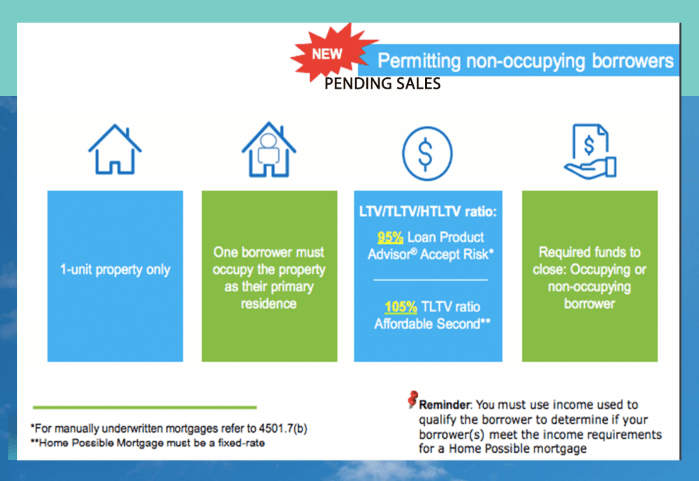
  • You must meet the debt-to-income ratio requirements for the program. Typically, this means that a maximum of 45% of your gross income goes toward your debts. 
  • Your income must fall within the stated guidelines, based on the location of the home. If you aren’t sure, use the eligibility tool on the Freddie Mac website.
  • You must also be considered a first-time homebuyer. This doesn’t mean that you’re excluded if you’ve owned a home in the past. There are exceptions for situations like inheriting a stake in a property or acting as a co-signer on a mortgage loan, or if you haven’t been on the title for another property within three years of applying to Home Possible.
  • You must complete an approved homebuyer education course. Courses are available online and in-person, and provides valuable information.


How Do I Apply for a Freddie Mac Home Possible Mortgage?

Screen Shot 2019-02-26 at 2.02.17 PM.png

  • Select a lender who offers Home Possible mortgage products.
  • Have the lender calculate your income based on Freddie Mac guidelines by providing the lender with some supporting documentation (like pay stubs, W-2 forms, and bank statements). Going through the preapproval process before home shopping will give you peace of mind.
  • Once you know how your income will be considered, work with a real estate agent to identify geographic areas you’d be interested in and confirm that you meet the maximum income requirements by using the eligibility tool.
  • Like conventional mortgages, when you have an offer accepted, your income, assets and credit will be reviewed and confirmed, and the property will be appraised to determine its value.


Uncategorized

10 Things to Consider When Buying a San Diego Home in 2019

Screen Shot 2019-01-11 at 2.30.21 PM.pngPhoto Credit: Evolve Vacation Rental Network


#1 – Which San Diego Neighborhood is Right for You?

From Hipster communities, to Business Districts, San Diego has so many unique neighborhoods to choose from. You should carefully consider these communities based on affordability, availability, and just what fits with your lifestyle. Ocean Beach, La Mesa, Mission Valley, North Park each have their own unique personality. Check out our last blog: Neighborhoods in San Diego for help with making your decision.

#2 – Have You Considered Cost of Living?

Right now, San Diego is the 13th most expensive city in America, according to USA Today. In the world, we’re 40th most expensive city. Not to be a Killjoy, but when it comes to money, too many of us consider salary without considering the cost of living. A high cost of living can drastically reduce the effectiveness of your income, and reduce your long-term wealth. Before purchasing a home in San Diego, make sure that your foreseeable day-to-day expenses are manageable.

#3- Do You Have a Mortgage Approval?

Required by the California Purchase Agreement, buyers need to obtain a mortgage approval. Before you go shopping for that great property, get a preapproval letter from a reputable mortgage company or brank. Contact me if you need help with this. It’s important to verify exactly what you can afford rather than waste your time searching for a home that is over your budget.

#4- Higher Loan Limits in 2019

As you’ve probably heard, borrowers in San Diego will enjoy higher loan limits this year. Federal housing officials have increased the loan limits for FHA, VA, and conventional mortgage loans. This means San Diego home buyers could have more properties to choose from without venturing into jumbo mortgage territory. As of January 1st, Fannie Mae and Freddie Mac loan limits have increased to $453,100 to $485,350 for a single-family home purchase.

#5 – Transportation

If you don’t own a car, or if you just like to take public transportation to sporting events and giant beach festivals, you might want to consider whether there are bus stops or a trolley station nearby. The San Diego Trolley is a great option for getting around the city quickly and avoiding traffic. You’ll also want to consider traffic near your area, especially during rush hours, and whether an Uber or Lyft driver can get to your area without trouble.

#6 – The San Diego Real Estate Market is Competitive

Although sellers have an advantage, San Diego real estate market is competitive for buyers. In a San Diego seller’s market, it’s important that as a buyer, you are realistic about how assertive and responsive you need to be in order to get the house you want. Sleeping on an offer overnight might not be an option this year.

#7 – Have You Chosen a Buyer’s Agent?

In such a heated seller’s environment, an experienced buyer’s agent, who knows this city, can give you that competitive edge. Hire a BA who’s an expert negotiator. It can make all the difference between getting your offer accepted, or losing out to another buyer and having to start again.

#8 – Demand is Higher at the lower end of the spectrum

In San Diego, the local real estate market is particular active at the lower end of the spectrum. By comparison, pricier properties are taking much longer to sell. If you’re buying a comparatively low-priced home in San Diego in 2019, you should be prepared for competition. This is because there is more demand in the “starter home” price range.

In fact, the fastest homes to sell fall between the $250-$500,000 range. If you’re looking for a property in this price range, jump quickly, and save yourself the frustration of losing out to other buyers.

#9 – Increasing Your Low Credit Rating

When it comes to improving your credit, there really is no time to waste. A low credit score may not seem like a big deal until it’s time to leverage your credit for a mortgage. Increasing your low credit rating will help you qualify for a higher-priced home, at a lower interest rate, making it more likely to purchase your dream home.

#10 – Setting Your Expectations and Formulating Your Plan

To recap, homebuyers interested in the San Diego market, are buying into one of the hottest real estate markets in the country. Therefore, it is important that you become informed prior to your search. Hiring help is always a great idea. Contact me so that I can help you set your expectations, formulate a plan, and ace this process, to make the most of your efforts.


Uncategorized

Five Golden Keys… to Purchasing a Second Home

Screen Shot 2018-11-24 at 1.19.45 PM

It’s hard to believe that the Holidays are already upon us. I know that buying a home right now is one of the furthest things on many of our minds right now. We’re thinking instead about Christmas gifts, decorating the house to get it ready for company, and not breaking the bank. I’m here to tell you that although mortgage rates are rising, they are still historically low, making this a great time to think about buying a second home. To make sure that your end-of-the-year-home-shopping a smooth process, instead of added Holiday stress, I’ve put together some key steps for you to follow:  

1. Find an Agent (Who Knows the Area)

Screen Shot 2018-11-24 at 1.25.57 PM

The best way to start the search for a second home is to hire a proper professional, and one who is familiar with your desired location. The necessary steps in the real estate process change over the years, so you might as well have someone on your side who’s well-versed in the nuances and can help ensure you get the best possible deal.

You always have the option to purchase a home without an agent’s help or put your house on the market as for sale by owner, however, if you’re not familiar with the buying or selling process, you may skip over necessary steps. An agent could provide you information about neighborhoods, market prices, and the pros and cons of particular properties. With their eye for the long-term value of a property, the agent could fill you in on price histories and how comparable sales have fared, as well as resale prospects.

As you may have found in purchasing your first home, agent services vary depending on the area you live in, price point, experience and availability of the agent and your ability to communicate your needs. While some agents will only help you get from point A to point B when finding and purchasing a house, others will attend inspections, tidy up the house in question, or even facilitate your entire move.

#2 – Determine Whether You Can Afford Two Mortgages

Screen Shot 2018-11-24 at 1.33.12 PM

First off, you have to qualify for a second-home mortgage, which will be an addition to any mortgage debt on your primary home. When you’re buying a home, mortgage lenders don’t look just at your income, assets, and the down payment you have. They look at all of your liabilities and obligations as well, including auto loans, credit card debt, child support, potential property taxes and insurance, and your overall credit rating.

You will need to make a down payment of at least ten to twenty percent, meet credit standards and debt-to-income requirements, and provide documents for income and asset verification. If you have a good relationship with the mortgage lender on your first home, that may be a good place to start in your quest for a second-home mortgage.

You can use a loan qualification calculator to check mortgage rates in your area.  Also, if you are thinking of tapping into your home equity you have built up on your primary residence to help pay for the second home, keep in mind that if you need that equity for an emergency, you may not be able to access it.

#3 – Factor in All Costs

Screen Shot 2018-11-24 at 1.30.30 PM

With trends like it is today, many second-home buyers are more interested in enjoying their property rather than simply obtaining a quick return on their investment. It’s important that you consider that you may still be away from the property a lot of the time, which usually entails additional costs, such as having a management company check the place in your absence for water leaks, frozen pipes or other problems.

Getting insurance for a second home may be more challenging than it is for a primary residence. This is because there are taxes that come with owning a second mortgage, and costs that will only apply to your second home. 

You should factor in costs that you may not have had to worry about with your first home. For example, if you are considering a second home on the beach, you’ll need flood insurance, in addition to regular home insurance. It has become more difficult to get flood insurance in coastal communities, and the cost has increased exponentially in some markets.

#4 – Consider Taxes and Tax Implications

Screen Shot 2018-11-24 at 1.35.58 PM

You may want to forget about deducting mortgage interest on a second home. If the home you were planning to buy is a vacation home, tax reform means you’ll pay more for your getaway.

While you could previously deduct mortgage interest on a second home as well as on a primary home — as long as your combined mortgages were under the $1 million cap — this is no longer permitted under the new rules. 

The Tax Cuts And Jobs Act caps to the mortgage interest deduction at $750,000. So if you already have a $750,000 mortgage and get a loan for a vacation home, you won’t be able to deduct the interest on the second mortgage. If you rent out your second home, you will have to consider additional tax ramifications, particularly if the rental period extends beyond 14 days a year.

The ban on deducting interest on a mortgage for a vacation home affects only new purchases, so if you already have a vacation home, you may want to hang onto it.

#5 – Consider Your Goals

Screen Shot 2018-11-24 at 1.38.26 PM

Whether you’re considering buying a second home to rent out, to move to and rent your old home, or what have you, there are some great benefits.

For one, you can sell your investment home and use the proceeds to buy another rental property without paying a capital gains tax. A rental property is a long-term investment, you could pay the mortgage with the rent income each month and pay off the mortgage without spending any of your own money. You will still be able to write-off the interest paid on your second home which is a huge plus.

When you’re ready to purchase a home, it may be beneficial to write out the goals you have for you and your family. Determine whether the second home will be a vacation home for you and your family, an emergency or guest home, or an additional income and for what purposes.

Know that writing down your goals isn’t the challenge. After all, with a word processing system, your laptop or even just pencil and paper, you can write down all the goals you like. The trick is coming up with effective goals you can realistically accomplish. Write down your needs (an adequate credit score, a substantial down payment and gross income that leaves enough for the house payment, etc.) and how you plan on going about fulfilling those needs.

I hope that all of this was helpful. If you have any questions or concerns, leave a reply below, as I’m always here to help.


Uncategorized

Everything You Need To Know About VA Loans

Screen Shot 2018-10-30 at 11.53.33 AM

What is a VA Loan?

VA loans are the most powerful lending program on the market, and are a lifesaver for the majority of military borrowers. This flexible, $0 down payment mortgage option are available to Veterans, Service Members, select military spouses, and have helped more than 22 million service members become homeowners since 1944. The loans are issued by private lenders and are popular as they are guaranteed by the U.S department of Veterans affairs (VA).

Why Get a VA Loan?

The VA home loan was created by the US government to help returning service members purchase homes without needing a down payment or excellent credit. Today, this program has guaranteed more than 22 million Service Members and their families purchase homes or refinance their mortgages.

In recent years, it has become even more important. Lenders have tightened their requirements in the wake of the housing market collapse, making the VA loan a lifeline Military homebuyers, many of whom find difficulty when faced with tough credit standards and down payment requirements.

VA LOANS TRADITIONAL MORTGAGES
0% Down

VA Loans are among the last 0% down home loans available on the market today.

Up to 20% Down

Conventional loans generally require down payments that can reach up to 20% to secure a home loan.

No PMI

Since VA Loans are government backed, banks do not require you to buy Private Mortgage Insurance.

PMI Required

Private Mortgage Insurance is a requirement for borrowers who finance more than 80% of their home’s value.

Competitive Interest Rates

The VA guaranty gives lenders a greater degree of safety and flexibility, which typically means a more competitive rate than non-VA loans.

Increased Risk for Lenders

Without government backing, banks are taking on more risk which, in turn, can result in a less-competitive interest rate on your home loan.

Easier to Qualify

Because the loan is backed by the government, banks assume less risk and have less stringent qualification standards for VA Loans, making them easier to obtain.

Standard Qualification Procedures

Conventional options hold stricter qualification procedures that can put homeownership out of reach for some homebuyers.


How do VA Loans Work (What Steps Are Needed)?

Get prequalified with a VA lender to get an estimate of how much house you can afford based on your income, credit, entitlement and other financial factors. You can get a quote with Veterans United Home Loans online at any time.

Get pre-approved. It puts you in the driver’s seat to take action when you find a home you love. Lenders will verify income and financial information (to get a clear sense of your purchasing power) and send you a preapproval letter. The letter shows real estate agents and home sellers you’re a strong and serious buyer.

Put in an offer when you and your agent find the perfect VA loan approved home. It’s important to find a VA loan savvy agent you trust that also knows the ins and outs of VA loans.

Get an Appraisal (and Underwriting): Once you’re under contract, your lender will order a VA appraisal of the property. Underwriters will evaluate your income, financial and related documents along with the appraisal once it’s finalized. If everything checks out, you’ll be issued a clear to close.

Close: You’ll sign all kinds of legal documents and paperwork at your loan closing and get the keys to your new home.


What Are Some Other Important Things to Know About VA Loans?

  1. They’re reusable. Your full VA entitlement can be used over and over again as long as you pay off the loan each time.


  1. They’re only for certain types of homes. They are mainly designed for properties in “move-in ready” condition, including single-family homes, condos, modular housing, some multi-unit properties and more.


  1. They’re for primary residences only. VA loans are for primary residences, not for investment property or a vacation home in Mexico, although you can use this benefit to buy a duplex or another multiunit property, provided you live in one of the units. The VA does offer exceptions to this rule.


  1. They’re not issued by the VA. Instead, the agency provides a guaranty on each qualified mortgage loan.


  1. They’re guaranteed by the government. The agency typically guarantees up to a quarter of the loan amount. The guaranty gives lenders confidence and helps service members secure great terms and rates.


  1. They’re available despite foreclosure or bankruptcy. Service members with a history of bankruptcy or foreclosure can secure a VA loan. Even borrowers who have had a VA loan foreclosed on can still utilize their VA loan benefit.


  1. They don’t have mortgage insurance. The VA’s guaranty eliminates the need for any mortgage insurance or mortgage insurance premium, helping borrowers save even more money each month.


  1. They come with a mandatory fee. There’s no mortgage insurance with VA loans, but there is the VA Funding Fee. This fee helps the VA keep the program going and is required on both purchase and refinance loans. It can be rolled into the loan amount and waived entirely for those with service-connected disabilities.


  1. They have limits on co-borrowers. Ulike other loan programs, the VA loan program does not let you get a loan with just about anybody. Having a co-borrower who isn’t your spouse or another veteran with VA loan entitlement will require a down payment, and not every VA lender offers these.

10. They don’t have a prepayment penalty. You can make extra payments any time you want, saving you a ton of interest. You can even structure your payments to automatically deduct a little extra every month.