

Uncategorized

A Simple Guide to Home Possible Mortgage Loans

What is a Home Possible Mortgage?

Screen Shot 2019-02-26 at 1.08.06 PM.png

Home Possible is a Freddie Mac mortgage program which allows first-time homebuyers with moderate incomes low down payment mortgage options. These programs only require 3-5% as the minimum down payment and features private mortgage insurance (PMI) that can be canceled once your home equity reaches 20%.


How can Home Possible help me?

Screen Shot 2019-02-26 at 1.02.40 PM.png

The Home Possible and the Home Possible advantage programs are geared toward first-time homebuyers with limited funds available for down payments, but meet the rest of the lending criteria. The purpose of both programs is to finance or refinance the purchases of primary residences, 2-4 unit owner-occupied homes, and eligible manufactured properties. Home Possible programs, with backing from Freddie Mac, are able to offer reduced mortgage insurance rates and premiums, more flexible credit terms, and refinancing options for existing homeowners.


What are its Main Advantages of Each HP Program?

Screen Shot 2019-02-26 at 1.13.27 PM.png

Home Possible Home Possible Advantage
  • Income Limits: The borrower’s annual income cannot exceed 100% of the area median income limits (or higher percentage in designated high-cost areas). No income limits apply if the property is in an underserved area.
  • Eligible Property: A one- to four-unit primary residence or a manufactured home that meets the guidelines.
  • Eligible Mortgages: First-lien, fully amortizing mortgages; fixed rate and adjustable rate loans are allowed. The maturity must not exceed 30 years.
  • LTV and DTI Ratios: Max 95% LTV, DTI Determined by Loan Product Advisor or 45% if manually underwritten.
  • Income Limits: Loan Product Advisor is used to determine whether the borrower’s income exceeds the product advisor limits.
  • Eligible Property: A 1-unit primary residence. Manufactured Homes not permitted
  • Eligible Mortgages: First-lien, fully amortizing mortgages; fixed rate loans only. Loan term cannot exceed 30 years.
  • LTV and DTI Ratios: Max 97% LTV, DTI determined by Loan Product Advisor or 43% if manually underwritten


Table source: http://www.valuepenguin.com

Commonalities:

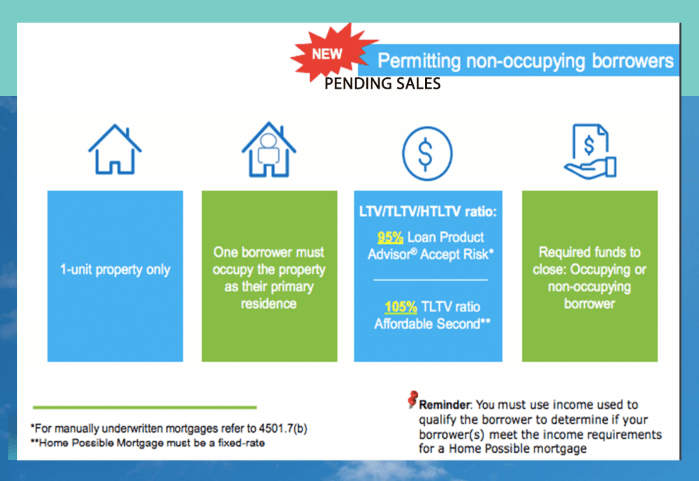
  • Borrowers must occupy the property as their primary residence.
  • Borrowers can not have an ownership interest in other properties.
  • Mortgage insurance rates and premiums match in both programs.
  • Mortgage insurance can be canceled after loan balance drops below 80% of the home’s appraised value.
  • Homeownership education is required for at least one qualifying borrower if all borrowers are first-time homebuyers.

Home Possible Loans Compared to Other loans?

Screen Shot 2019-02-26 at 1.11.53 PM.png

Home Possible vs. FHA Loans

Although each program offers reduced mortgage insurance rates and premiums, which reduces your overall housing expense — with HP loan programs, the mortgage insurance can be canceled once you reach a 78% to 80% loan-to-value ratio. This avoids the expense of refinancing just to eliminate mortgage insurance in the future. In addition, Freddie Mac mortgages aren’t subject to Federal Housing Administation (FHA) county loan limits, which could restrict your purchase options. 

Home Possible vs. VA Loans

Unlike loans from the Department of Veterans Affairs (VA), there’s no funding fee on Home Possible loans. Having fewer upfront costs keeps initial loan balances lower, requires lower monthly payments and less interest over the loan term.

Freddie Mac Home Possible vs. Conventional Loans

Home Possible offers more flexible credit terms than most conventional loans and accepts scenarios on a case-by-case basis which increases the chances that your mortgage application will be approved. HP even allows borrowers without credit scores to qualify based on acceptable automated underwriting results and payment references. 


How Do I Qualify for a Freddie Mac Home Possible Mortgage?
Screen Shot 2019-02-26 at 1.38.24 PM.png

  • You must meet the debt-to-income ratio requirements for the program. Typically, this means that a maximum of 45% of your gross income goes toward your debts. 
  • Your income must fall within the stated guidelines, based on the location of the home. If you aren’t sure, use the eligibility tool on the Freddie Mac website.
  • You must also be considered a first-time homebuyer. This doesn’t mean that you’re excluded if you’ve owned a home in the past. There are exceptions for situations like inheriting a stake in a property or acting as a co-signer on a mortgage loan, or if you haven’t been on the title for another property within three years of applying to Home Possible.
  • You must complete an approved homebuyer education course. Courses are available online and in-person, and provides valuable information.


How Do I Apply for a Freddie Mac Home Possible Mortgage?

Screen Shot 2019-02-26 at 2.02.17 PM.png

  • Select a lender who offers Home Possible mortgage products.
  • Have the lender calculate your income based on Freddie Mac guidelines by providing the lender with some supporting documentation (like pay stubs, W-2 forms, and bank statements). Going through the preapproval process before home shopping will give you peace of mind.
  • Once you know how your income will be considered, work with a real estate agent to identify geographic areas you’d be interested in and confirm that you meet the maximum income requirements by using the eligibility tool.
  • Like conventional mortgages, when you have an offer accepted, your income, assets and credit will be reviewed and confirmed, and the property will be appraised to determine its value.




Uncategorized

Prepare for your First Home Loan (Mentally, Spiritually, and Emotionally)

There’s no disputing that a home will be one of the biggest and most important purchases of your life. It’s an exhilarating, taxing, wonderful event. However, armed with the knowledge you need to begin the home loan process, it can be a satisfying experience.

Many advisors will inform you of what documents you’ll need to prepare. There are countless articles and workshops about collecting your checks, paystubs, W2s, and receipts, and they aren’t incorrect, however I’d like to offer you a few conceptual, and maybe uncommon, steps that you’ll need to shop for a home, apply for a mortgage, and close with the confidence that you got your money’s worth.

1. KNOW YOURSELF Screen Shot 2018-09-12 at 1.55.26 PM

First time home buying is about knowing yourself, what your life goals are, your priorities, and knowing how to use your income, assets and/or credit in a way that works for you.

I don’t say this lightly, but for some, getting a home might not be the best thing to do right now. I’m not trying to discourage you, but not everyone is at a place in their life to be able to afford a home. Let me explain.

I have a friend (I’ll call him Joe) who grew up in a household where his single father lived life paycheck to paycheck, and not necessarily because he had to, but because his father had been taught by his mother who happened to take life as it came, without thinking too hard about saving.

Consequently, as great a woman as Joe’s grandmother was, Joe has never been able to spend money smartly. In fact, every month he spends more money than he has.

Now, for Joe, he’ll need to first practice paying off small purchases now, until he is able to work his way up to affording to owe on a home loan. Otherwise, he may find himself biting off more than he can chew.

Before applying for a loan it’s important to know yourself, know what type of spender you are, what type of payment plan would work for lifestyle, and if it’s a good plan for your life right now.

2. FIND WAYS TO SIMPLIFY Screen Shot 2018-09-12 at 1.49.26 PM

We’re marketed to everyday. Everywhere we go, there are people telling us what our life should be or what life that we should have. As soon we turn on our TVs and our devices, we receive messages: If you buy this, you’re going to have that life. Go here or buy this and it’ll be worth your while, your taste buds will dance, your kids will be happy, you will be popular, admired and attractive!

I like to tell people to consider living a minimal lifestyle. Minimalism can be a tool in helping you find simplicity and subsequently, freedom. Most people hear that M word and immediately think they’ll have to downsize their possessions. In reality, minimalism is about making all of your decisions more consciously and deliberately.

We want to be able to spend more time with our kids, family or friends. We want to spend our time in a more balanced way. For instance, we all know that we should be exercising. In January, we all go out and buy these gym memberships. This is good news for fitness and nutrition companies, they capitalize on this want for a better life.

I’m not saying not to buy that gym membership. I’m not saying to empty out your home and get rid of that beautiful collection of books. In fact, if you’re happy and it doesn’t cause stress, then continue to do that thing.

If any aspects of your life IS causing you stress (not the good stress where you’re learning and growing, but the type where you’re not sleeping at night because you feel like you didn’t make the right decision) cut it out of your life.

I’ve been working on this aggressively, because I’m a collector, shopper and all around early adopter of anything electronic! And I can tell you, when you simplify your life because you want to align your life to support your values, that’s when happiness occurs. When minimalism is coming from a place of fear, and you’re throwing things out because you think some type of Zen will magically occur if you empty out your house, it won’t work.

3. REEVALUATE Screen Shot 2018-09-12 at 1.52.08 PM

To start simplifying your life, you need to reevaluate what your life is. The first thing you have to do is stop and consider what your grand, massive, colossal life-goal is. This is the thing that keeps you going—maybe it’s to become the CEO of an international clothing design company, or to have a non-profit historical museum. Perhaps it’s just to have a happy, stress-free, intentional life. Now ask yourself what is standing between you and your goal.

I like tell folks to identify their pain points. Maybe you have a hour-and-a-half commute to work every day. People can spend 1000 a month or more on transportation because of extra costs, they need need a better car, gas millage, maintenance, they need to house the car, parking, etc. When really, maybe they should live closer to work.

I understand, sometimes you look at your life, you want your kids to be in a certain school district, you want to be close to your parents, you like a certain coffee shop. Ask yourself if the lifestyle you’re maintaining is worth anything you’re giving up, including your financial freedom.

It’s important to be authentic. When you’re trying to be inauthentic, trying to impress others, not being honest with yourself about whether you can afford all the credit cards that you have, or whatever the case may be, it’s very hard to take a step back and evaluate your day-to-day choices and not judge yourself. You can start this new life anytime!

I am going to tell you now that you will need to collect your important papers, your paystubs, and documents, documents, documents, but really, the first step is to realize how you want to live, what lifestyle you want, what works for your lifestyle right now, and what works for your eventual goal.