Uncategorized

Seller Buydown (For Buyers)

More Tips and Tricks on the LoansByJoanna Guide

Coming soon: Seller Buydown (For Sellers)

…………………………………………………………………………………………………………………………………………………..

When you qualify for a home loan, you’re actually qualifying for the monthly payments

We know that for a home buyer, nothing takes priority quite like having an affordable mortgage payment. The price you’ll be approved for depends entirely on both your down payment and the maximum payment for which you qualify. And the most significant factor in determining what that payment will be is your interest rate.

For those buyers who opt to use an interest rate reduction mortgage, your real estate agent will negotiate with the seller to accept a fair price if they will give you credit to permanently reduce, or buydown, your interest rate.

Just a reduction of 0.25% in your interest rate could mean tens of thousands of dollars of interest that you will save over the term of your home loan. And this, of course, can mean the difference between affording your dream home and going with option B.

At the end of the day, this is a win-win situation for both the buyer and the seller of a home.

Using this credit (also known as a seller’s concession) to permanently lower your interest rate will lead to a reduction in your mortgage payment, allowing you to afford a higher sales price while keeping your payments right where you needed them to be all along.

The seller benefits as much as the buyer in that the seller gets the offer they wanted, and your below-market interest rate means a lower total payment— even though you offered a fair purchase price at market value.

You may be thinking, “Why don’t I just ask the seller to reduce the price of the home?”

That’s a great question, and most buyers are going to default to assuming this is the way to go. But using an interest rate reduction mortgage means your offer will stand out from the competition. A higher offer gives you a higher chance of sealing the deal.

Because it’s been established you aren’t trying to take any precious money out of the seller’s pocket (by having to make a lower offer), your far more desirable offer will inevitably stand out from all of the other buyers trying to get the lowest price possible.

While a desperate seller may take a low offer, most sellers are going to take the offer that will allow them to make the most money from the sale. Period.

If your offer keeps your payment where you want it to be while the seller also gets what they want, then everybody wins.

A successful negotiation is when all parties feel like they got the best deal. You get your payment. The seller receives their money. Everybody wins when everybody wins.

………………………………………………………………………………………………………………………………………………….

More Tips and Tricks on the LoansByJoanna Guide

Coming soon: Seller Buydown (For Sellers)

Uncategorized

Seller Credits: How They Work, How They Benefit you in the Home Buying Process, How Much you Really End Up Spending on Your New Home? 

Screen Shot 2019-09-30 at 11.06.37 AM

Imagine trying to buy a Starbucks Frappuccino and having to separately compute what it costs to make the coffee, to pay for the coffee bean collectors, distribute the inventory, and stock the store. Wouldn’t it be nice if houses came with a bottom-line price tag, from upfront fees to ongoing monthly expenses, so that a buyer could easily compare “all-in” costs?

The costs of buying a home can very quickly add up. After you decide that homeownership is your best bet, you’ll need to convince a lender of that too. That means that your credit is in good shape, you aren’t struggling with debt, and you have a sizeable cushion for expenses that may arise. 

For financed deals, in addition to a down payment, you pay loan-acquisition costs and for services used during the escrow process. You may ask the seller to credit you a specified amount at closing to help with many of the expenses. 

Homeowners anxious to sell their homes will sometimes entice buyers with seller credits. These credits are a loan option that allows buyers to finance their closing costs and be able to purchase their home with less cash down. The seller concession must be included in the sales contract, and the amount and terms of the credit can be negotiated. 

Homeowners anxious to sell their homes will sometimes entice you with seller credits. These credits are a loan option that allows you to finance your closing costs and be able to purchase their home with less cash down. Here are 4 things that you should do (and know) as a buyer:

1.) Review closing costs

To settle the transaction, you and the seller will pay your own share of closing costs including escrow fees, title insurance, and property taxes. The allocation of fees depend on market customs. Buyers are typically required to pay only the fees that are considered customary and reasonable for a particular market, and the seller credit covers fees that fit the description. Lenders cap the amount of fees a seller credit may cover at 3-9% of the loan amount.

2.) Negotiate the terms

If you are the buyer, you and the seller will typically negotiate the terms of a seller credit early in the transaction. You will request an amount, as a percentage or dollar amount, in the offer to purchase. The seller may accept, reject, or counter the seller credit. The seller pays the credit as a lump sum at closing, and limitations to what the credit covers may apply. 

3.) Enjoy The Benefits

Seller credits can be beneficial to both sides of the transactions. As a buyer, you may be offered seller credit that can reduce your out-of-pocket expenses at closing. You can even request a seller credit, and increase the sales price to entice a seller to accept. A seller credit allows you to finance your closing costs into the new loan amount, however, your lender must approve the credit, and the value of the home must merit the increase in sale price. 

4.) Know The Limitations

Limitations on what the buyer and a seller credit can pay for are placed by lenders. Prohibited items are known as non-allowable fees. If you overestimate our closing costs, a credit surplus may occur. Then, you should renegotiate the sale price for the unused amount so that the seller does not end up with more net proceeds at closing for the unused portion. 

Whether the seller markets the home with an offer to credit some of your closing costs, or you request that the seller assists in your offer, the process for applying the credit is generally the same: the amount of the credit is noted in the sales contract as a dollar amount or as a percentage of the offer price, then, it’s added to the offer price.

Because the buyer adds the concession to the offer price, he increases the amount he pays for the home. For example, a buyer who needs $3,000 in concessions for a $100,000 home requests 3 percent seller assist and offers $103,000 for the home. Although the buyer is paying $103,000 for the house, the seller nets only $100,000 – the remaining $3,000 is loan money the buyer applies to his closing costs.

Sellers often feel as though they’re “giving” the buyer the amount of the assist. However, the assist amount is built into the offer price. The buyer is offering the seller $100,000 but asking the lender to originate a loan based on a $103,000 purchase price.


Uncategorized

Dreaming of a Second Home

You work hard during the week! Maybe you need a nice relaxation spot to spend your weekends or holidays. Maybe retirement is just over the horizon and you want to start enjoying the perks of owning a second home. Maybe you’ve already retired and are looking for an oasis to visit often. Whatever the case, a second home may be within your reach!

Many of us dream of a beachfront home. California, with its perfect weather, endless activities, and unbelievable seafood, is a frontrunner. Popular So Cal spots include La Jolla, Encinitas, Redondo Beach, and Dana Point. Second homes, however, don’t have to be near a beach. Imagine vacationing in historic areas such as Riverside, Avalon, and Julian. Whatever the case, many choose to live in So Cal full time because of the quality of life, weather, things to do, and is a dream for so many of us.

I hear all types of questions when it comes to owning a second home. Common questions include:

  • What is the minimum down payment on a second home?
  • Can I buy a second home that will eventually be my retirement home?
  • Is flood insurance required?
  • What are the second home mortgage options?

Okay, let’s break this down.

1.) What is the Down Payment Requirement on a Second Home Purchase?

Many people believe that buying a second home (or even a primary home) requires 20% down. Although buying a principal residence has more low to no down payment options such as VA, FHA, and USDA, lower down payments for second homes are still available if you know where to look.

For example, as little as 10% of the purchase price could be allowed as a down payment. An additional way of keeping the out of pocket funds low would be to include seller paid costs for the buyer. When buying a second home and financing between 75.01% – 90% of the price, the seller is allowed to pay 6% of the sales towards the buyer’s closing costs and pre-paids. If the loan amount is 75% or less of the price, then the seller may pay 9% toward costs.

Low down payment requirements make owning a second home more obtainable, and luckily, there are plenty of sources. Down payment sources (for funds to close) include bank accounts, retirement account withdrawal, retirement account loan, investment accounts, home equity loan/line on the primary, sale of another home or asset, and gift funds (after the minimum requirements are met).

Discuss these possible sources with your mortgage loan officer to find out if there are any other requirements and to discuss whether one option may have advantages over another for your situation.

2.) Can I Buy a Second Home That Will Eventually Be My Retirement Home?

This is an excellent question, and a very popular request these days. Enjoying a home while you can, before possibly moving into the home permanently may be ideal. Occasionally, the question, “Is it okay to buy a property as a second home and then convert it to a primary residence down the road?” The answer is, yes! That is perfectly fine, as long as the intention was to buy as secondary, it was used as secondary, and eventually converted to primary down the road.

As long as you can afford the two homes, this would be a great way to prepare for the enjoyment of a vacation property, learn about the area, maybe vacation there, and then eventually use it a lot!

3.) Is Flood Insurance Required?

A lot of times, buying a second home means living close to a body of water, whether it be a lake, pond, waterway, or ocean. If this is the case, the structure may be in a flood hazard area, and flood insurance is required. If you are considering a home with flood insurance, ask the seller for a copy of existing flood policy, elevation certificate, and survey. These help the buyer’s lender and insurance company determine whether or not the property requires flood insurance.

If flood insurance is required, these could help get the quote, and prove that the home is not in the flood hazard area. If flood insurance is not required, it may still be a good idea to obtain flood insurance, and because the structure is not in a hazard area, the flood insurance premium would be much cheaper. As always, consult with a knowledgeable agent about your best options.

4.) What Are My Second Home Mortgage Options?

This is an excellent question, and a very popular request these days. Enjoying a home While government loans such as FHA, VA, and USDA may be for primary residences, Fannie Mae and Freddie Mac conventional loans, as well as jumbo loans allow for second home financing. Plus, there are advantages to using conventional loans, such as flexible guidelines with student loan debt, low mortgage insurance rates for high scores, up to 50% debt ratio, condo financing, and second home renovation loans. Conventional loans are limited to the county conforming loan limits, but that’s where a jumbo loan comes in handy. Jumbo loans provide financing for luxury homes exceeding these limits.

If you’re looking to find your dream vacation getaway, retirement oasis, or just a second home, contact me and I can help you with the process!


Uncategorized

A Simple Guide to Home Possible Mortgage Loans

What is a Home Possible Mortgage?

Screen Shot 2019-02-26 at 1.08.06 PM.png

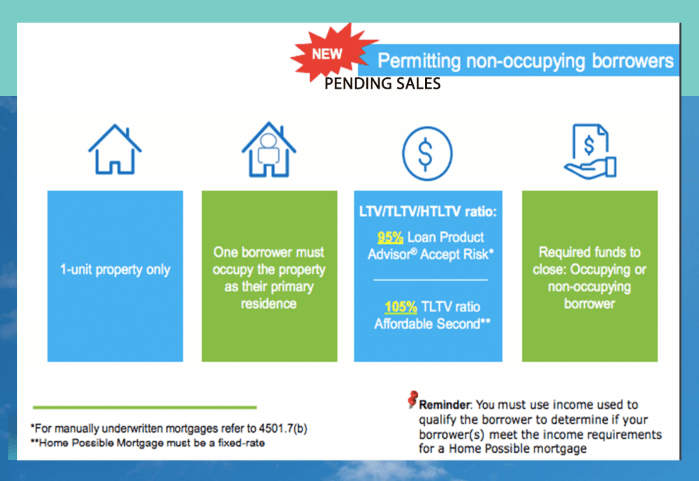
Home Possible is a Freddie Mac mortgage program which allows first-time homebuyers with moderate incomes low down payment mortgage options. These programs only require 3-5% as the minimum down payment and features private mortgage insurance (PMI) that can be canceled once your home equity reaches 20%.


How can Home Possible help me?

Screen Shot 2019-02-26 at 1.02.40 PM.png

The Home Possible and the Home Possible advantage programs are geared toward first-time homebuyers with limited funds available for down payments, but meet the rest of the lending criteria. The purpose of both programs is to finance or refinance the purchases of primary residences, 2-4 unit owner-occupied homes, and eligible manufactured properties. Home Possible programs, with backing from Freddie Mac, are able to offer reduced mortgage insurance rates and premiums, more flexible credit terms, and refinancing options for existing homeowners.


What are its Main Advantages of Each HP Program?

Screen Shot 2019-02-26 at 1.13.27 PM.png

Home Possible Home Possible Advantage
  • Income Limits: The borrower’s annual income cannot exceed 100% of the area median income limits (or higher percentage in designated high-cost areas). No income limits apply if the property is in an underserved area.
  • Eligible Property: A one- to four-unit primary residence or a manufactured home that meets the guidelines.
  • Eligible Mortgages: First-lien, fully amortizing mortgages; fixed rate and adjustable rate loans are allowed. The maturity must not exceed 30 years.
  • LTV and DTI Ratios: Max 95% LTV, DTI Determined by Loan Product Advisor or 45% if manually underwritten.
  • Income Limits: Loan Product Advisor is used to determine whether the borrower’s income exceeds the product advisor limits.
  • Eligible Property: A 1-unit primary residence. Manufactured Homes not permitted
  • Eligible Mortgages: First-lien, fully amortizing mortgages; fixed rate loans only. Loan term cannot exceed 30 years.
  • LTV and DTI Ratios: Max 97% LTV, DTI determined by Loan Product Advisor or 43% if manually underwritten


Table source: http://www.valuepenguin.com

Commonalities:

  • Borrowers must occupy the property as their primary residence.
  • Borrowers can not have an ownership interest in other properties.
  • Mortgage insurance rates and premiums match in both programs.
  • Mortgage insurance can be canceled after loan balance drops below 80% of the home’s appraised value.
  • Homeownership education is required for at least one qualifying borrower if all borrowers are first-time homebuyers.

Home Possible Loans Compared to Other loans?

Screen Shot 2019-02-26 at 1.11.53 PM.png

Home Possible vs. FHA Loans

Although each program offers reduced mortgage insurance rates and premiums, which reduces your overall housing expense — with HP loan programs, the mortgage insurance can be canceled once you reach a 78% to 80% loan-to-value ratio. This avoids the expense of refinancing just to eliminate mortgage insurance in the future. In addition, Freddie Mac mortgages aren’t subject to Federal Housing Administation (FHA) county loan limits, which could restrict your purchase options. 

Home Possible vs. VA Loans

Unlike loans from the Department of Veterans Affairs (VA), there’s no funding fee on Home Possible loans. Having fewer upfront costs keeps initial loan balances lower, requires lower monthly payments and less interest over the loan term.

Freddie Mac Home Possible vs. Conventional Loans

Home Possible offers more flexible credit terms than most conventional loans and accepts scenarios on a case-by-case basis which increases the chances that your mortgage application will be approved. HP even allows borrowers without credit scores to qualify based on acceptable automated underwriting results and payment references. 


How Do I Qualify for a Freddie Mac Home Possible Mortgage?

Screen Shot 2019-02-26 at 1.38.24 PM.png

  • You must meet the debt-to-income ratio requirements for the program. Typically, this means that a maximum of 45% of your gross income goes toward your debts. 
  • Your income must fall within the stated guidelines, based on the location of the home. If you aren’t sure, use the eligibility tool on the Freddie Mac website.
  • You must also be considered a first-time homebuyer. This doesn’t mean that you’re excluded if you’ve owned a home in the past. There are exceptions for situations like inheriting a stake in a property or acting as a co-signer on a mortgage loan, or if you haven’t been on the title for another property within three years of applying to Home Possible.
  • You must complete an approved homebuyer education course. Courses are available online and in-person, and provides valuable information.


How Do I Apply for a Freddie Mac Home Possible Mortgage?

Screen Shot 2019-02-26 at 2.02.17 PM.png

  • Select a lender who offers Home Possible mortgage products.
  • Have the lender calculate your income based on Freddie Mac guidelines by providing the lender with some supporting documentation (like pay stubs, W-2 forms, and bank statements). Going through the preapproval process before home shopping will give you peace of mind.
  • Once you know how your income will be considered, work with a real estate agent to identify geographic areas you’d be interested in and confirm that you meet the maximum income requirements by using the eligibility tool.
  • Like conventional mortgages, when you have an offer accepted, your income, assets and credit will be reviewed and confirmed, and the property will be appraised to determine its value.


Uncategorized

10 Things to Consider When Buying a San Diego Home in 2019

Screen Shot 2019-01-11 at 2.30.21 PM.pngPhoto Credit: Evolve Vacation Rental Network

#1 – Which San Diego Neighborhood is Right for You?

From Hipster communities, to Business Districts, San Diego has so many unique neighborhoods to choose from. You should carefully consider these communities based on affordability, availability, and just what fits with your lifestyle. Ocean Beach, La Mesa, Mission Valley, North Park each have their own unique personality. Check out our last blog: Neighborhoods in San Diego for help with making your decision.

#2 – Have You Considered Cost of Living?

Right now, San Diego is the 13th most expensive city in America, according to USA Today. In the world, we’re 40th most expensive city. Not to be a Killjoy, but when it comes to money, too many of us consider salary without considering the cost of living. A high cost of living can drastically reduce the effectiveness of your income, and reduce your long-term wealth. Before purchasing a home in San Diego, make sure that your foreseeable day-to-day expenses are manageable.

#3- Do You Have a Mortgage Approval?

Required by the California Purchase Agreement, buyers need to obtain a mortgage approval. Before you go shopping for that great property, get a preapproval letter from a reputable mortgage company or brank. Contact me if you need help with this. It’s important to verify exactly what you can afford rather than waste your time searching for a home that is over your budget.

#4- Higher Loan Limits in 2019

As you’ve probably heard, borrowers in San Diego will enjoy higher loan limits this year. Federal housing officials have increased the loan limits for FHA, VA, and conventional mortgage loans. This means San Diego home buyers could have more properties to choose from without venturing into jumbo mortgage territory. As of January 1st, Fannie Mae and Freddie Mac loan limits have increased to $453,100 to $485,350 for a single-family home purchase.

#5 – Transportation

If you don’t own a car, or if you just like to take public transportation to sporting events and giant beach festivals, you might want to consider whether there are bus stops or a trolley station nearby. The San Diego Trolley is a great option for getting around the city quickly and avoiding traffic. You’ll also want to consider traffic near your area, especially during rush hours, and whether an Uber or Lyft driver can get to your area without trouble.

#6 – The San Diego Real Estate Market is Competitive

Although sellers have an advantage, San Diego real estate market is competitive for buyers. In a San Diego seller’s market, it’s important that as a buyer, you are realistic about how assertive and responsive you need to be in order to get the house you want. Sleeping on an offer overnight might not be an option this year.

#7 – Have You Chosen a Buyer’s Agent?

In such a heated seller’s environment, an experienced buyer’s agent, who knows this city, can give you that competitive edge. Hire a BA who’s an expert negotiator. It can make all the difference between getting your offer accepted, or losing out to another buyer and having to start again.

#8 – Demand is Higher at the lower end of the spectrum

In San Diego, the local real estate market is particular active at the lower end of the spectrum. By comparison, pricier properties are taking much longer to sell. If you’re buying a comparatively low-priced home in San Diego in 2019, you should be prepared for competition. This is because there is more demand in the “starter home” price range.

In fact, the fastest homes to sell fall between the $250-$500,000 range. If you’re looking for a property in this price range, jump quickly, and save yourself the frustration of losing out to other buyers.

#9 – Increasing Your Low Credit Rating

When it comes to improving your credit, there really is no time to waste. A low credit score may not seem like a big deal until it’s time to leverage your credit for a mortgage. Increasing your low credit rating will help you qualify for a higher-priced home, at a lower interest rate, making it more likely to purchase your dream home.

#10 – Setting Your Expectations and Formulating Your Plan

To recap, homebuyers interested in the San Diego market, are buying into one of the hottest real estate markets in the country. Therefore, it is important that you become informed prior to your search. Hiring help is always a great idea. Contact me so that I can help you set your expectations, formulate a plan, and ace this process, to make the most of your efforts.