Uncategorized

Seller Credits: How They Work, How They Benefit you in the Home Buying Process, How Much you Really End Up Spending on Your New Home? 

Screen Shot 2019-09-30 at 11.06.37 AM

Imagine trying to buy a Starbucks Frappuccino and having to separately compute what it costs to make the coffee, to pay for the coffee bean collectors, distribute the inventory, and stock the store. Wouldn’t it be nice if houses came with a bottom-line price tag, from upfront fees to ongoing monthly expenses, so that a buyer could easily compare “all-in” costs?

The costs of buying a home can very quickly add up. After you decide that homeownership is your best bet, you’ll need to convince a lender of that too. That means that your credit is in good shape, you aren’t struggling with debt, and you have a sizeable cushion for expenses that may arise. 

For financed deals, in addition to a down payment, you pay loan-acquisition costs and for services used during the escrow process. You may ask the seller to credit you a specified amount at closing to help with many of the expenses. 

Homeowners anxious to sell their homes will sometimes entice buyers with seller credits. These credits are a loan option that allows buyers to finance their closing costs and be able to purchase their home with less cash down. The seller concession must be included in the sales contract, and the amount and terms of the credit can be negotiated. 

Homeowners anxious to sell their homes will sometimes entice you with seller credits. These credits are a loan option that allows you to finance your closing costs and be able to purchase their home with less cash down. Here are 4 things that you should do (and know) as a buyer:

1.) Review closing costs

To settle the transaction, you and the seller will pay your own share of closing costs including escrow fees, title insurance, and property taxes. The allocation of fees depend on market customs. Buyers are typically required to pay only the fees that are considered customary and reasonable for a particular market, and the seller credit covers fees that fit the description. Lenders cap the amount of fees a seller credit may cover at 3-9% of the loan amount.

2.) Negotiate the terms

If you are the buyer, you and the seller will typically negotiate the terms of a seller credit early in the transaction. You will request an amount, as a percentage or dollar amount, in the offer to purchase. The seller may accept, reject, or counter the seller credit. The seller pays the credit as a lump sum at closing, and limitations to what the credit covers may apply. 

3.) Enjoy The Benefits

Seller credits can be beneficial to both sides of the transactions. As a buyer, you may be offered seller credit that can reduce your out-of-pocket expenses at closing. You can even request a seller credit, and increase the sales price to entice a seller to accept. A seller credit allows you to finance your closing costs into the new loan amount, however, your lender must approve the credit, and the value of the home must merit the increase in sale price. 

4.) Know The Limitations

Limitations on what the buyer and a seller credit can pay for are placed by lenders. Prohibited items are known as non-allowable fees. If you overestimate our closing costs, a credit surplus may occur. Then, you should renegotiate the sale price for the unused amount so that the seller does not end up with more net proceeds at closing for the unused portion. 

Whether the seller markets the home with an offer to credit some of your closing costs, or you request that the seller assists in your offer, the process for applying the credit is generally the same: the amount of the credit is noted in the sales contract as a dollar amount or as a percentage of the offer price, then, it’s added to the offer price.

Because the buyer adds the concession to the offer price, he increases the amount he pays for the home. For example, a buyer who needs $3,000 in concessions for a $100,000 home requests 3 percent seller assist and offers $103,000 for the home. Although the buyer is paying $103,000 for the house, the seller nets only $100,000 – the remaining $3,000 is loan money the buyer applies to his closing costs.

Sellers often feel as though they’re “giving” the buyer the amount of the assist. However, the assist amount is built into the offer price. The buyer is offering the seller $100,000 but asking the lender to originate a loan based on a $103,000 purchase price.


Uncategorized

A Simple Guide to Home Possible Mortgage Loans

What is a Home Possible Mortgage?

Screen Shot 2019-02-26 at 1.08.06 PM.png

Home Possible is a Freddie Mac mortgage program which allows first-time homebuyers with moderate incomes low down payment mortgage options. These programs only require 3-5% as the minimum down payment and features private mortgage insurance (PMI) that can be canceled once your home equity reaches 20%.


How can Home Possible help me?

Screen Shot 2019-02-26 at 1.02.40 PM.png

The Home Possible and the Home Possible advantage programs are geared toward first-time homebuyers with limited funds available for down payments, but meet the rest of the lending criteria. The purpose of both programs is to finance or refinance the purchases of primary residences, 2-4 unit owner-occupied homes, and eligible manufactured properties. Home Possible programs, with backing from Freddie Mac, are able to offer reduced mortgage insurance rates and premiums, more flexible credit terms, and refinancing options for existing homeowners.


What are its Main Advantages of Each HP Program?

Screen Shot 2019-02-26 at 1.13.27 PM.png

Home Possible Home Possible Advantage
  • Income Limits: The borrower’s annual income cannot exceed 100% of the area median income limits (or higher percentage in designated high-cost areas). No income limits apply if the property is in an underserved area.
  • Eligible Property: A one- to four-unit primary residence or a manufactured home that meets the guidelines.
  • Eligible Mortgages: First-lien, fully amortizing mortgages; fixed rate and adjustable rate loans are allowed. The maturity must not exceed 30 years.
  • LTV and DTI Ratios: Max 95% LTV, DTI Determined by Loan Product Advisor or 45% if manually underwritten.
  • Income Limits: Loan Product Advisor is used to determine whether the borrower’s income exceeds the product advisor limits.
  • Eligible Property: A 1-unit primary residence. Manufactured Homes not permitted
  • Eligible Mortgages: First-lien, fully amortizing mortgages; fixed rate loans only. Loan term cannot exceed 30 years.
  • LTV and DTI Ratios: Max 97% LTV, DTI determined by Loan Product Advisor or 43% if manually underwritten


Table source: http://www.valuepenguin.com

Commonalities:

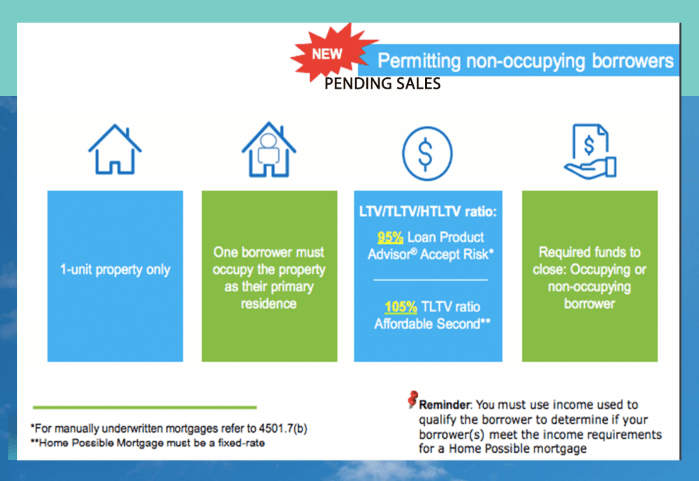
  • Borrowers must occupy the property as their primary residence.
  • Borrowers can not have an ownership interest in other properties.
  • Mortgage insurance rates and premiums match in both programs.
  • Mortgage insurance can be canceled after loan balance drops below 80% of the home’s appraised value.
  • Homeownership education is required for at least one qualifying borrower if all borrowers are first-time homebuyers.

Home Possible Loans Compared to Other loans?

Screen Shot 2019-02-26 at 1.11.53 PM.png

Home Possible vs. FHA Loans

Although each program offers reduced mortgage insurance rates and premiums, which reduces your overall housing expense — with HP loan programs, the mortgage insurance can be canceled once you reach a 78% to 80% loan-to-value ratio. This avoids the expense of refinancing just to eliminate mortgage insurance in the future. In addition, Freddie Mac mortgages aren’t subject to Federal Housing Administation (FHA) county loan limits, which could restrict your purchase options. 

Home Possible vs. VA Loans

Unlike loans from the Department of Veterans Affairs (VA), there’s no funding fee on Home Possible loans. Having fewer upfront costs keeps initial loan balances lower, requires lower monthly payments and less interest over the loan term.

Freddie Mac Home Possible vs. Conventional Loans

Home Possible offers more flexible credit terms than most conventional loans and accepts scenarios on a case-by-case basis which increases the chances that your mortgage application will be approved. HP even allows borrowers without credit scores to qualify based on acceptable automated underwriting results and payment references. 


How Do I Qualify for a Freddie Mac Home Possible Mortgage?

Screen Shot 2019-02-26 at 1.38.24 PM.png

  • You must meet the debt-to-income ratio requirements for the program. Typically, this means that a maximum of 45% of your gross income goes toward your debts. 
  • Your income must fall within the stated guidelines, based on the location of the home. If you aren’t sure, use the eligibility tool on the Freddie Mac website.
  • You must also be considered a first-time homebuyer. This doesn’t mean that you’re excluded if you’ve owned a home in the past. There are exceptions for situations like inheriting a stake in a property or acting as a co-signer on a mortgage loan, or if you haven’t been on the title for another property within three years of applying to Home Possible.
  • You must complete an approved homebuyer education course. Courses are available online and in-person, and provides valuable information.


How Do I Apply for a Freddie Mac Home Possible Mortgage?

Screen Shot 2019-02-26 at 2.02.17 PM.png

  • Select a lender who offers Home Possible mortgage products.
  • Have the lender calculate your income based on Freddie Mac guidelines by providing the lender with some supporting documentation (like pay stubs, W-2 forms, and bank statements). Going through the preapproval process before home shopping will give you peace of mind.
  • Once you know how your income will be considered, work with a real estate agent to identify geographic areas you’d be interested in and confirm that you meet the maximum income requirements by using the eligibility tool.
  • Like conventional mortgages, when you have an offer accepted, your income, assets and credit will be reviewed and confirmed, and the property will be appraised to determine its value.